
Grand County Three-Day Release Status
The Grand County Sheriff's official Jail Inmate List does not provide a rolling 72-hour release archive. It shows a date-stamped current inmate offense list. Research found no release filter, previous-page archive, public update schedule, or stated period for keeping a released booking online. Paging through or comparing current-list images cannot recreate a full three-day log.
The reliable substitute is an interval request. Write the start date and time, the end date and time, and Mountain Time. Ask for every publicly releasable release-log entry within that span. A three-day result may include bond, own-recognizance release, time served, court order, sentence completion, or transfer. The event label and destination must stay with each row, because a transfer ends Grand County custody without putting the person in the community.
Request Grand County 72-Hour Releases
The jail telephone is best for an urgent status check. The Sheriff's GRAMA process is the documentary route. GRAMA means Utah's Government Records Access and Management Act, the state law governing access and classification of public agency records. The countywide open-records portal redirects Sheriff records to the Sheriff's own process, so use the correct office from the start.
- Choose the exact three-day interval in Mountain Time. Avoid the vague phrase “over the weekend.”
- Review the current jail list and note its update date, while treating it only as a custody snapshot.
- Call Grand County Jail at 435-259-8115 to check any urgent or named-person question.
- Open the Sheriff GRAMA instructions, complete the current form, and attach the photo identification it requests.
- Describe the date range and desired release fields with reasonable specificity. Add a booking or case number when known.
- Ask for electronic delivery, releasable portions after redaction, and an advance estimate above a chosen fee ceiling.
The Sheriff states an ordinary response period of 10 working days and a five-working-day period for a qualifying expedited request. That does not turn GRAMA into a live feed. Call the 24/7 line when the answer cannot wait. The written record is valuable when the precise release timestamp, releasing authority, or destination must be retained.
The official GRAMA screen shows the local submission rules.
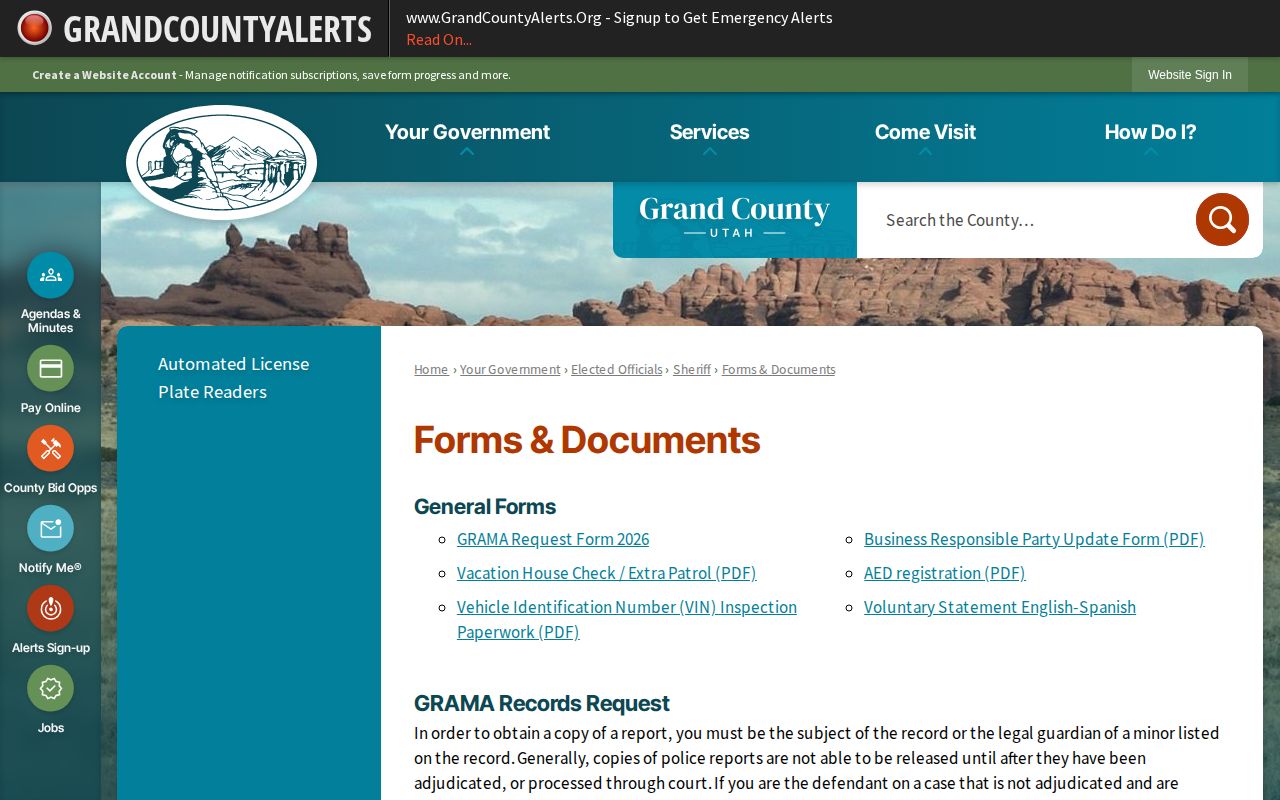
Those instructions support a focused three-day request rather than a broad search for all jail records.
Note: Request by timestamp and booking number where possible, since names alone can join different people or separate bookings incorrectly.
Grand County 72-Hour Release Fields
A useful three-day list needs more than names. The current roster's observed fields were Booking #, Name, Name Number, and charge rows showing statute, offense description, court, offense code, and class. It did not show a release date, release type, destination, bond, or booking photograph. The requested release log should seek the following fields, while recognizing that the custodian may redact restricted material or state that a field does not exist in the local system.
| Release-log field | Reason to request it |
|---|---|
| Name and booking number | Distinguishes people and multiple bookings within the same three days. |
| Booking date and time | Connects the exit event to the correct admission. |
| Release date and time | Places the event inside or outside the 72-hour boundary. |
| Release reason or code | Separates bond, court order, time served, sentence completion, and transfer. |
| Releasing authority | Identifies which legal or agency action directed the release. |
| Destination agency | Reveals whether another custodian received the person. |
| Charges, court, and bond | Points to the court record that can explain the case action. |
Ask for the native release record and its available field definitions. Do not fill gaps from a copied roster. A cache may retain a name after release, omit a later transfer, or concern another place named Grand County. An unavailable field should remain unavailable rather than be inferred.
Grand County Weekend Release Checks
A 72-hour interval is especially useful when normal office days do not match the custody event. Someone may leave on a Friday evening, Saturday, Sunday, or holiday while the records counter is closed. Grand County does not publish routine release hours, weekend processing rules, a standard release exit, or an online update cadence. Families should call the jail before driving to Moab or choosing a pickup point.
Use actual timestamps instead of phrases such as “last weekend.” For example, a request can name Friday at a set Mountain Time through Monday at the same time. This makes the boundary auditable and prevents the date from shifting with the requester's location. If one record falls just outside the range, adjust the interval rather than claiming the roster missed it.
The jail record proves the operational release or transfer. A court docket proves the judicial authority and later case result. One may show a bond or release order while the other supplies the exact time staff carried it out. Search by booking number and case number to join them with less risk of a name collision.
For an urgent check limited to today, the Released Last 24 Hours workflow uses a tighter interval and the same official sources.
Why Grand County Releases Vanish
The current roster is built to report who is held, not to preserve who left. A person may stop appearing after bond, time served, a court order, dismissal, transfer, or a data correction. Grand County publishes no post-release retention period for the webpage. Underlying booking-and-release records can continue to exist even when the public display changes, subject to Utah retention and access rules.
The county's date stamp also does not promise how often staff update the image list. A newly processed event may not align with the viewer's assumed cutoff. Comparing screenshots can produce a lead, but not a verified list. The exact-time GRAMA request is stronger because it asks the custodian for the event record rather than deriving it from absence.
The researched current-list view makes the absence of a released-only control visible.
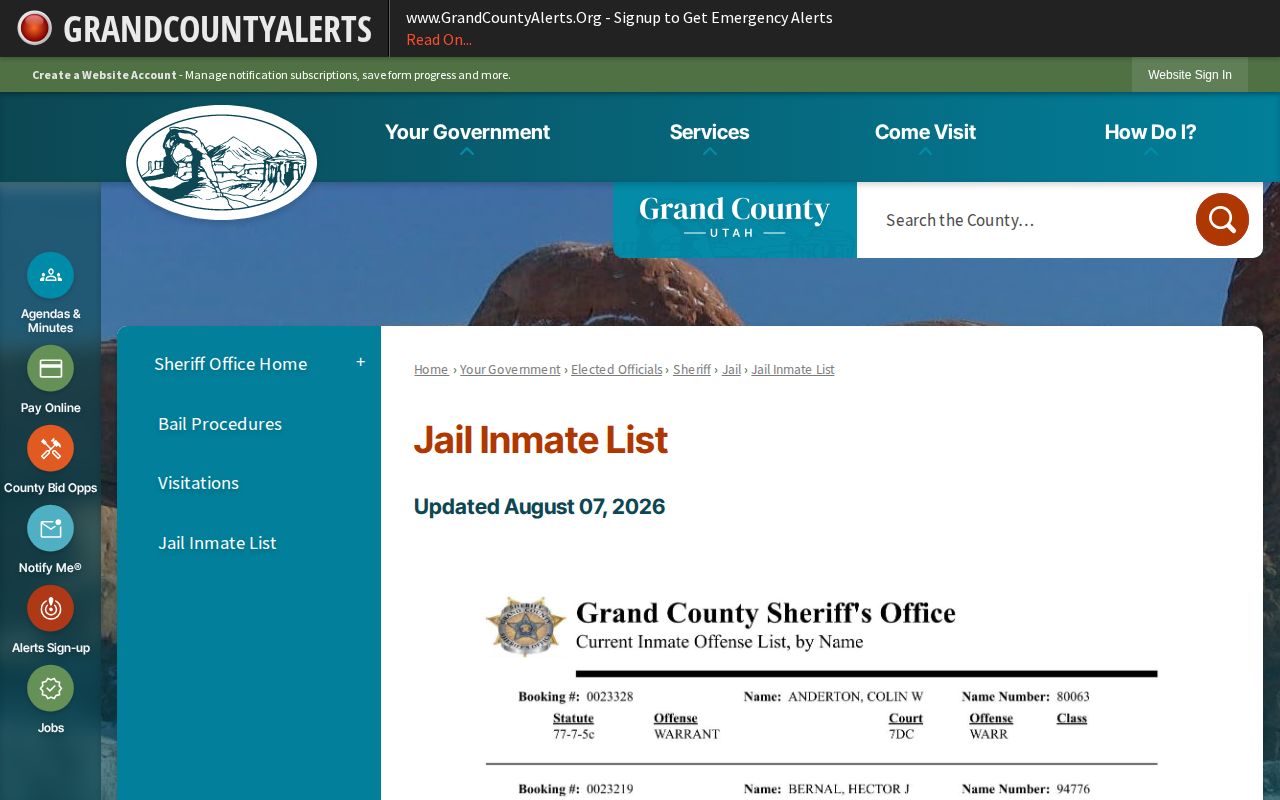
The screenshot should be read as a current-custody interface, not as proof that no release occurred during the prior three days.
Note: Web visibility and agency record retention are different, so a missing roster entry does not mean the source record was deleted.
Grand County Release Custody Paths
Before using a fallback system, identify the legal custodian. Grand County Jail records answer whether local custody ended. The Utah Department of Corrections handles state prisoners and people on felony parole or probation. A state inmate may be housed in a contract county jail while remaining a UDC case, and UDC says almost all such releases are processed through the Utah State Correctional Facility. The local roster cannot replace UDC and Board evidence for that event.
| Situation | Best record path | What it proves |
|---|---|---|
| Recent Grand County booking | Jail call and Sheriff release sheet | Local release or transfer time and type |
| Utah prison or supervision | UDC search, Board decision, UDC record | State status, planned parole, or discharge evidence |
| Pending local case | Utah court docket and order | Judicial authority and disposition, not exact door time |
| Federal or immigration transfer | BOP or ICE system after the local entry | Status in the successor system only |
Utah VINE can help with prospective release alerts when the supplying agency participates. It is not a complete historical 72-hour log, and a missed alert is not proof that no custody change occurred. A BOP “Released” result also concerns federal custody only. An ICE result concerns ICE custody. Preserve the Grand County transfer record that connects those systems.
Confirm Grand County Three-Day Releases
Read each source for the fact it owns. The jail release sheet is the best local proof that Grand County custody ended. The court order explains the legal action. A UDC record and Utah Board decision address state parole or discharge. VINE supplies notifications, while federal and immigration locators address their own agencies. Absence from all searches can result from spelling, lag, restricted access, full discharge, sealing, or an expunged case. It is not affirmative proof.
If the release sheet contains an apparent error, send the Sheriff records custodian the booking number, disputed field, proposed correction, and supporting official record. Direct a court error to the court and a UDC status error to UDC. A clerical correction and expungement are different processes.
The result of a sound 72-hour search is not merely a list of names. It is a set of event records tied to exact times, release types, authorities, and destinations. That detail is what separates a confirmed community release from a transfer and a live record from a guess based on roster disappearance.
Note: Keep the returned time zone and agency labels with each entry so the three-day record remains clear after the search.