
Grand County Projected Versus Actual Release
A future date is a plan, calculation, or decision point. Actual release is the event when the custodian ends confinement or transfers the person. For Grand County Jail, a booking-and-release sheet should show the operational time and release type. The court docket can show legal authority such as bond, a court order, jail credit, or sentence completion, but it may not show the exact moment the jail acted.
Pretrial detainees often have no set release date. Their custody turns on bond, release conditions, later hearings, or another court order. A definite county jail sentence may be computed from the sentencing order and credit for time already served. Grand County has not published a local good-time formula or weekend-release policy, so no general calculator can supply a safe answer.
State cases have more layers. The sentencing court imposes a statutory range, and the Utah Board of Pardons and Parole determines whether and when parole occurs within lawful limits. A parole date does not mean sentence discharge. Parole begins after prison release and continues until termination or expiration.
Find Grand County Inmate Release Dates
Classify the custodian before searching. Grand County's current jail list cannot provide a past or future release date. For a local case, use the court order and call the jail. For a state sentence, begin with UDC Offender Search, then compare the Board's decision. The live UDC detail has used “Release Date/Type,” which is not the same label as “projected release date” and may be blank or unavailable.
- Collect the full name, birth date, booking or case number, and UDC number if applicable.
- Decide whether Grand County Jail, UDC, or another system holds legal custody.
- For county custody, read the sentencing or release order and ask the jail how it was applied.
- For UDC custody, search by offender number and record the exact date labels shown.
- Search the Board by name or offender number for the controlling decision and later review.
- After release, obtain the jail sheet or UDC record rather than treating the earlier date as final proof.
The full Grand County release-record workflow covers a focused GRAMA request when a local release must be documented.
Open the official UDC search to review its current fields and coverage warning.
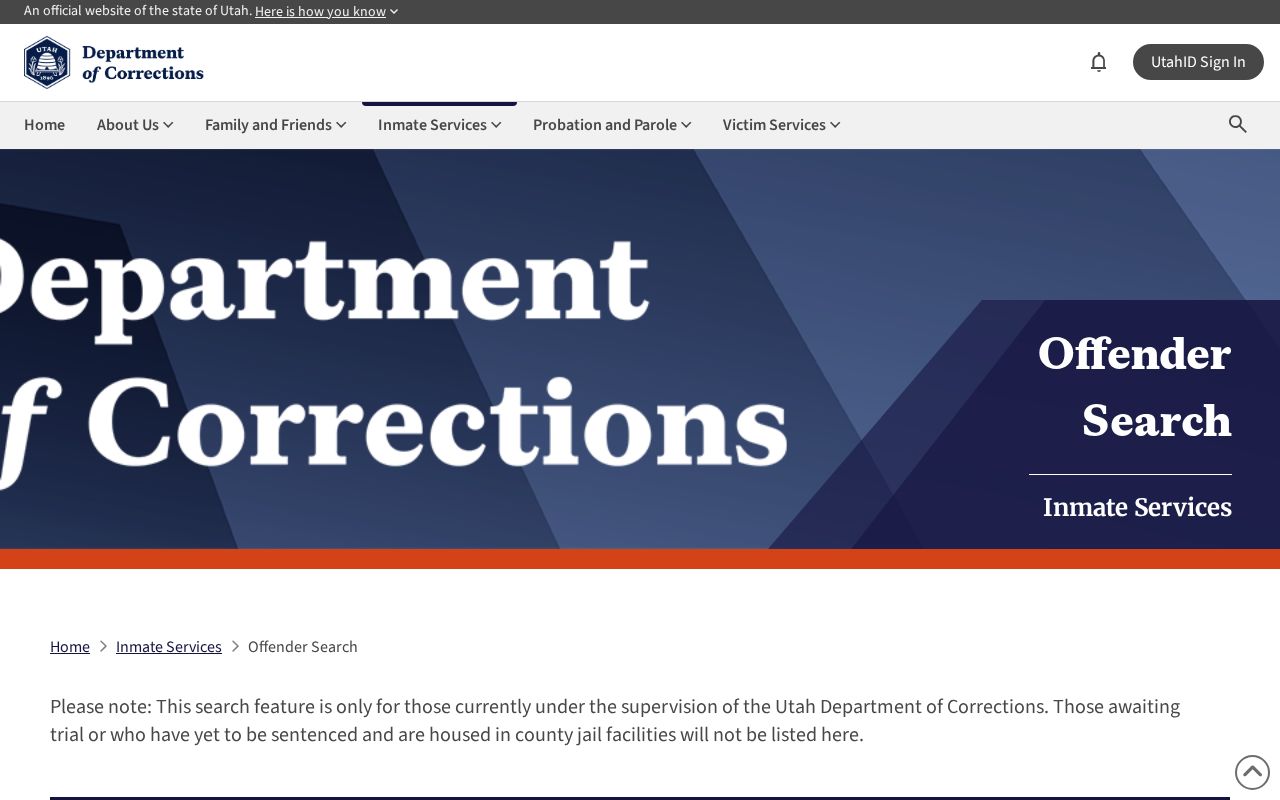
The captured search reinforces that UDC covers current incarceration and supervision, not unsentenced Grand County detainees or every fully discharged person.
Utah Earned Time Release Rules
Utah Code section 77-27-5.4 governs the state earned-time program. The Board must establish the program and grants at least four months of credit for each of up to two qualifying programs in a case action plan. That can produce as much as eight months of mandatory credit, while the Board retains authority for added discretionary credit.
The rule has key limits. Exclusions can apply when a release date is too near for transition services, the sentence is life without parole, the Board has ordered sentence expiration, no current release date exists, a release contingency remains unmet, or a termination date has already been set. The Board can forfeit credit when it finds a rescission hearing is needed. Program completion may be considered at the next hearing when no release date exists.
Utah does not impose a universal requirement that every state prisoner serve exactly 85 percent. That shorthand comes from other systems and should not be applied to a Grand County state case. Sections 77-27-7 and 77-27-9 govern original hearings and parole proceedings, while mandatory minimums and offense-specific laws may control an individual sentence.
Read the official earned-time statute before applying it to a current Board decision.
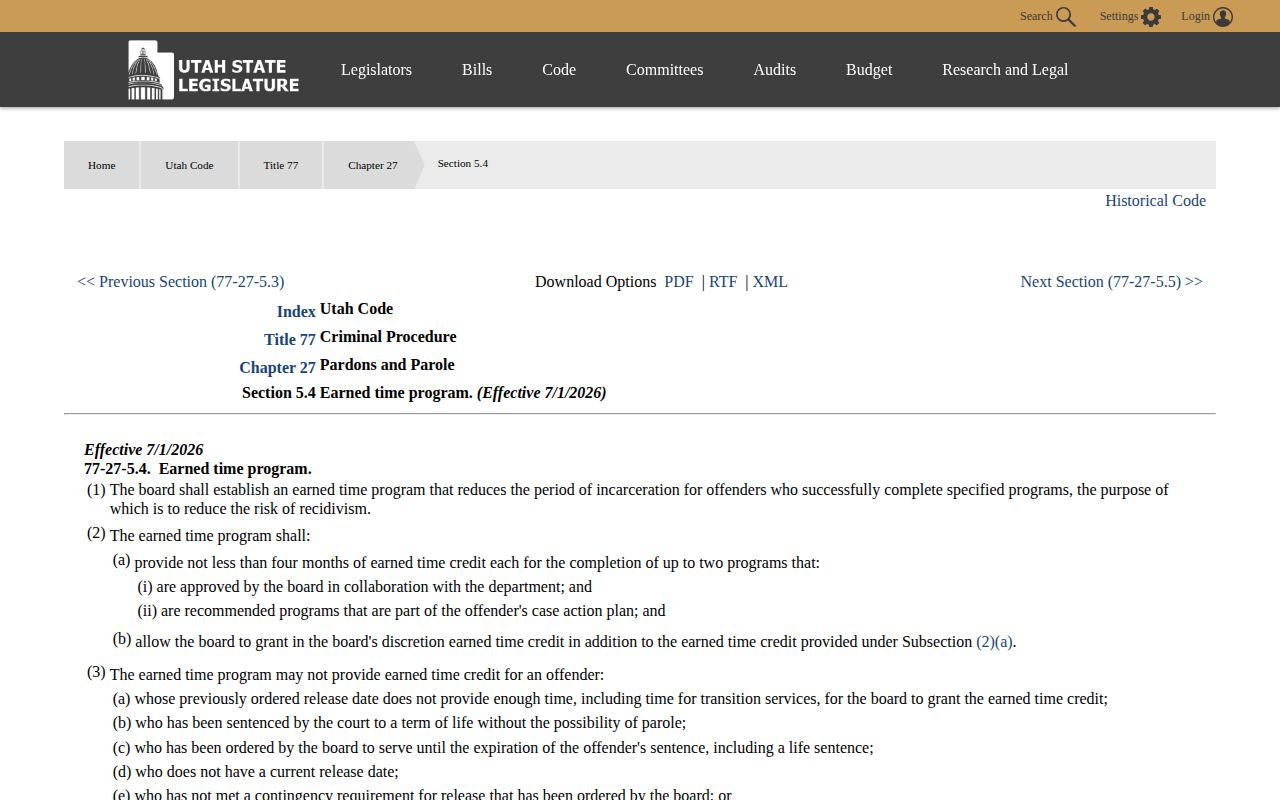
The statute shows why earned time is a Board-administered credit, not a simple date subtraction for every Utah prisoner.
Why Grand County Release Dates Change
A release estimate can move for legal, administrative, or conduct-based reasons. In a local case, a judge can amend the sentence or apply custody credit. In a state case, the Board evaluates sentence structure, offense facts, reports, institutional conduct, case-plan progress, risk, supervision history, and the release plan. Guidelines inform the decision but do not create a right to release.
| Factor | Possible effect | Best confirmation |
|---|---|---|
| Custody credit or amended order | Changes a county sentence calculation | Court order and jail record |
| Earned-time completion | May affect a Board-controlled state date | Board decision and UDC record |
| Conduct or rescission review | Can delay or remove a future parole date | Later Board order |
| Detainer or hold | May turn local release into transfer | Release destination and successor agency |
| Concurrent or consecutive terms | Changes the total state sentence calculation | Board and sentencing records |
| Parole grant, denial, or rehearing | Sets or postpones the release decision | Published Board decision |
A detainer is a request or hold from another agency. It can end Grand County custody without placing the person in the community. The destination field matters as much as the time. A future Board grant can also be rescinded before physical release when new information or conduct requires review.
Note: Use the newest dated order because an older Grand County or Board record may describe a plan that was later changed.
Confirm Grand County Release Dates
For Grand County Jail, call 435-259-8115 and ask whether the person is held, released, or transferred. Request the exact time, reason, authority, and destination. When a durable record is needed, use the Sheriff's GRAMA form for the booking-and-release sheet and cite the booking or case number. The current jail list is only a current-custody snapshot.
For UDC, compare Offender Search with the Board's Search Hearings and Decisions tool. A currently supervised record may show legal status, facility placement, Board dates, and parole, termination, or expiration information. A fully terminated person may no longer appear, so a Board order or written UDC termination record is stronger evidence.
Utah VINE can provide a pending custody alert. Registration and limits are covered in the VINELink Release Check. Confirm the notice with the agency that supplied it. BOP and ICE use separate federal systems and cannot be verified through Utah VINE.
Where Grand County State Releases Happen
A person linked to Grand County may be released physically in Salt Lake City. UDC's Release Day instructions say paroles and releases are processed on Tuesdays at Utah State Correctional Facility. This includes almost all state prisoners housed in contract county jails. Releases directly from a county jail are described as extremely rare, with family notified when that exception applies.
Custody and release locations can therefore differ. Someone held at Central Utah Correctional Facility or a contract county jail may travel to USCF for processing. A person entering a community correctional center is transported by UDC. That structured residential placement is not the same as an unrestricted community release.
Check UDC's current Release Day directions before arranging travel.
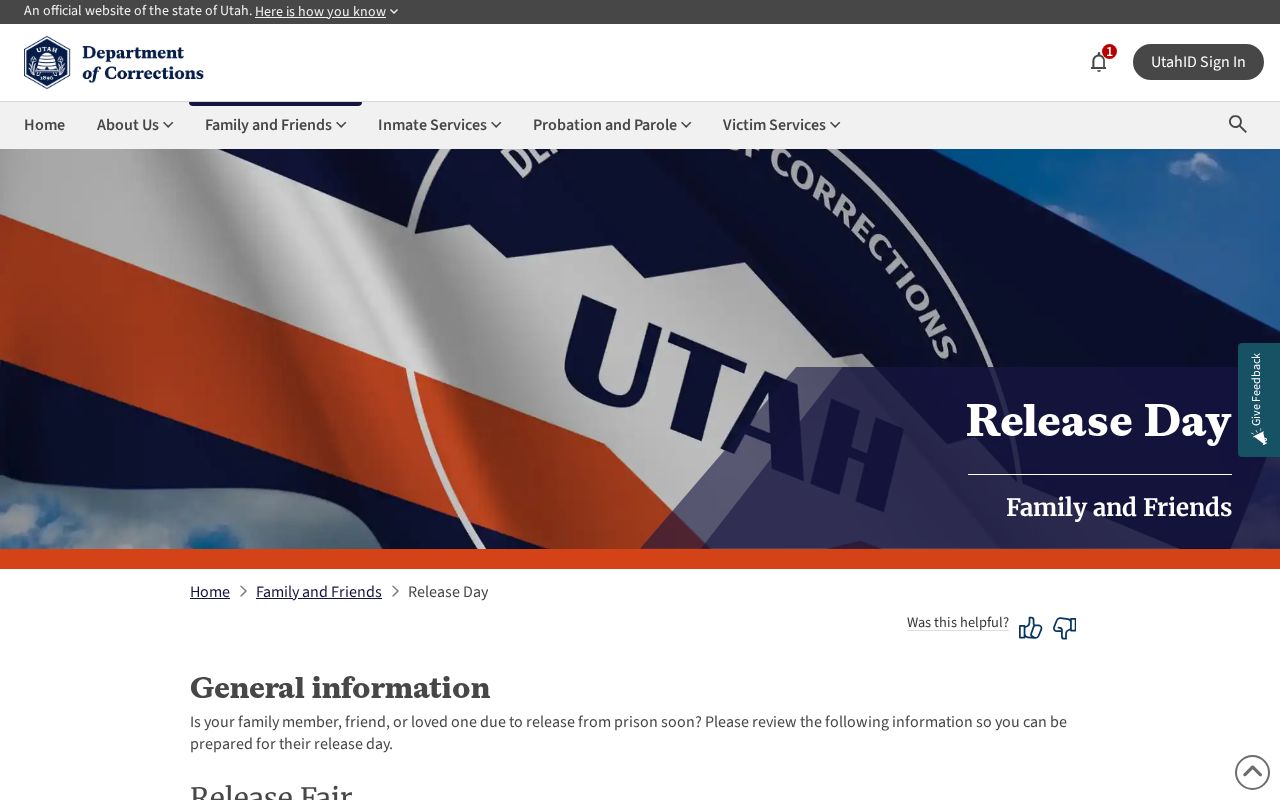
The official instructions show why legal custody must be identified before a family chooses Moab or Salt Lake City as the pickup location.
Grand County Release Date Labels
Three common labels answer three different questions. An original hearing date is when the Board first considers a state case. A parole or release date is tied to intended release under a Board or UDC record. An expiration or termination date concerns the end of the sentence or supervision. None should be silently renamed “projected release date.”
The UDC public interface has shown a “Release Date/Type” field, while UDC's public-information description separately refers to a “Parole/Expiration Date.” Either field may be blank or unavailable. Record the label with the value. If the field lacks useful detail, use the Board decision and request the public UDC record rather than guessing what the agency meant.
After physical release, parole may continue. Utah Code section 77-27-12 addresses parole discharge and sentence termination. The final supervision record is therefore as important as the prison release record when the question is whether all state control has ended.
Note: A hearing date marks Board review, not the day a Grand County person necessarily leaves custody.
Grand County Jail Date Calculation
A definite local jail term starts with the signed sentencing order. Read the number of days, whether terms run at the same time or one after another, and any credit awarded for time already served. Then ask Grand County Jail how staff applied that order to the custody record. The corrections-deputy role published by the county confirms that jail staff maintain release documentation and release prisoners whose dates have been authorized.
No official Grand County source located in the research publishes a routine good-time formula, two-for-one rule, weekend adjustment, holiday-release policy, or standard release hour. Those gaps matter. Applying a UDC earned-time rule to a county sentence would mix two systems. The safe record is the court order plus the jail's own calculation and final release sheet.
Bond release follows a different path. It is pretrial release, not sentence completion. Grand County says credit-card bail is handled through the Seventh District or Justice Court during their stated business hours, and the jail itself does not accept credit-card bail. A bond transaction date may help explain timing, but the jail entry remains the source for actual release.
After a Grand County Release Date
Once the planned day arrives, confirm what occurred. A county record may show release to the community, bond, time served, a court order, or transfer. A UDC record may show parole to the community, placement at a community correctional center, or expiration. Leaving one building does not always end custody or supervision.
For state parole, the Moab Region 6 AP&P office may supervise a person returning to Grand County or San Juan County. Its role starts after prison release and does not replace the Board's decision. Later parole discharge or sentence termination is another event, supported by a Board or UDC record. Keep the physical release date and the supervision end date separate.
If the expected event did not occur, review the newest Board order, court order, detainer information, and legal status. A rescission review, unmet contingency, new hold, sentence amendment, or data lag can explain the difference. Do not change an official label or calculate a substitute date from assumptions.