
Grand County Federal Release Scope
No official source identified a BOP prison in Grand County. The Federal Bureau of Prisons system appears in the local custody map because a Grand County booking or court case can lead to a federal hold, a U.S. Marshals transfer, later BOP commitment, or eventual federal release elsewhere. The agency named in each record determines what the next search can prove.
A Grand County Jail entry showing federal transfer ends the local booking but does not establish community release. USMS often handles federal pretrial detention and transport. BOP generally becomes the relevant prison source after commitment. Later, a BOP result may show “Released” or “Not in BOP Custody,” yet another law-enforcement system or federal supervised release may still apply.
| Record or status | What it establishes | What it does not establish |
|---|---|---|
| Grand County transfer entry | County custody ended toward a named federal custodian | That the person entered the community |
| USMS detention record | Federal pretrial or transport custody | BOP sentence release |
| BOP “Released” with date | BOP custody ended on the displayed date | End of all supervision or another hold |
| Federal court order | Judicial authority and case outcome | The precise operational handoff unless stated |
Search a Federal Release
The official BOP Inmate Locator generally covers records from 1982 to the present. Search by BOP register, FBI, INS, or DCDC number when one is known. A number is safer than a common name. The biographical search accepts name and can use age, race, and sex to narrow a possible match.
Results can show name, register number, age, race, sex, release date, and a location or status. Read the label exactly. “Released” with a date is evidence that BOP custody ended, while “Not in BOP Custody” must be interpreted with the rest of the record. A community placement or another correctional status can require more review. BOP also cautions that another correctional or law-enforcement system may be involved.
- Collect the federal register number from the court file or prior BOP record when possible.
- Search by number, then use name and biographical filters if needed.
- Compare every identifier before choosing a result.
- Record the exact location or status text and the release date as labeled.
- Match the result to the District of Utah case and any Grand County transfer record.
- Use BOP FOIA when a documentary release record is needed beyond the locator result.
The Grand County release search shows how to preserve the county record before following the federal custody trail.
BOP Locator Result Fields
The BOP locator is designed for national federal custody, not one Utah county. It does not need a Grand County filter. Identity numbers connect the federal result to the court and transfer records that carry local context. Older custody before the locator's general coverage period may require a records request rather than an online hit.
The official BOP locator source is pictured below and shows the available number and biographical search routes.
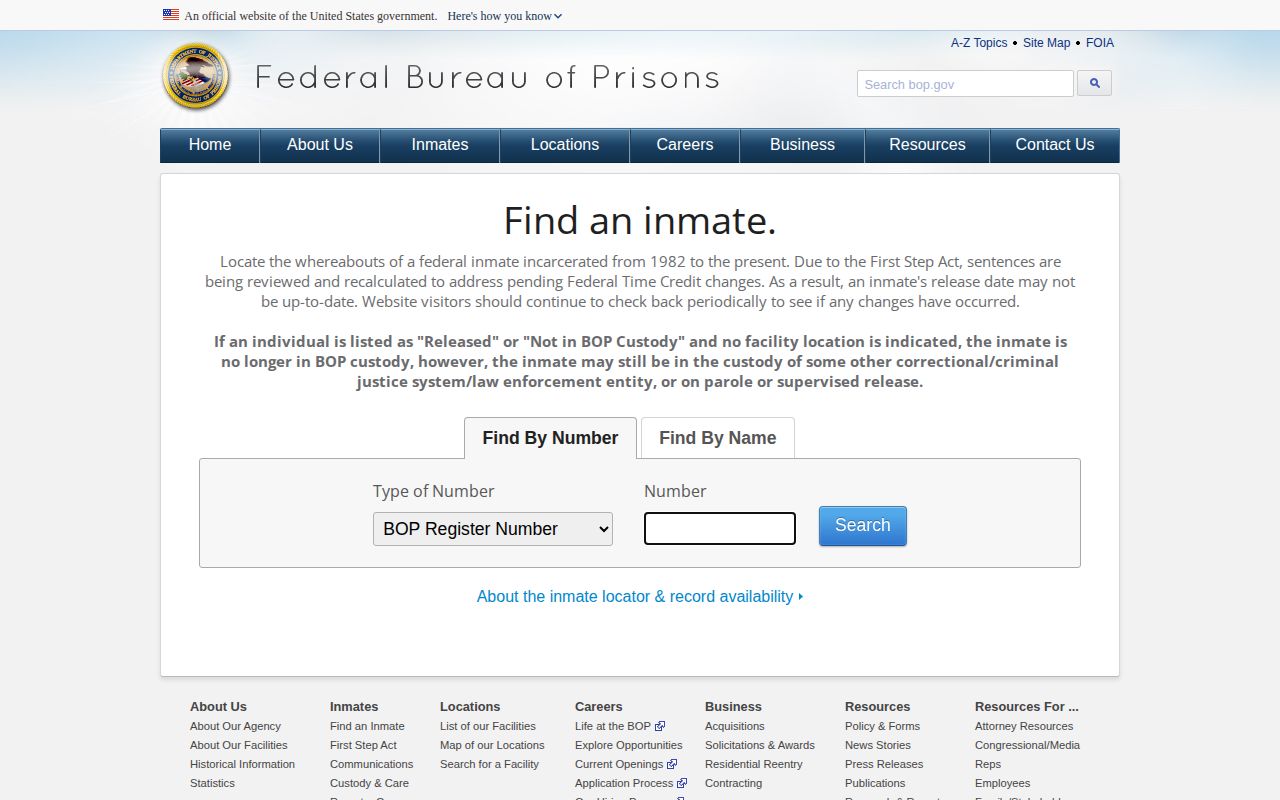
The captured fields support a person-specific search, while the federal court case supplies the Grand County connection.
Future dates can change. BOP notes that First Step Act recalculations may affect dates, and custody events such as detainers or transfers can change what happens at the end of the BOP term. Treat a future display as current agency information rather than a promise of the physical event.
- Register number
- The BOP identifier used to distinguish people with similar names.
- Released
- A locator status indicating the person is no longer in BOP custody as recorded.
- Not in BOP Custody
- A BOP-specific status that does not rule out another custodian.
- Detainer
- A request or hold that can direct the next custody step after one agency's term.
Federal Release Records Route
For documentary proof, use BOP FOIA. Identify the person by full name and register number, name the institution if known, and ask for the release date and method or other publicly releasable fields needed to verify the event. A broad demand for all files can slow classification and review. A narrow request makes the intended record easier to locate.
BOP Form BP-A714, Notice of Release and Arrival, illustrates possible fields within the federal process: inmate name, release date and method, register or FBI number, institution, transport or detainer information, supervision jurisdiction, proposed residence, and a reporting instruction. The existence of that form does not make every private destination field suitable for public repetition. Ask for the releasable portion and respect redactions.
Federal Bureau of Prisons systemNo BOP prison identified in Grand County
Public route: BOP Inmate Locator
Document route: BOP FOIA
Relevant federal court district: District of Utah
The BOP status explanation is shown in the official source image below.
Read the BOP custody and reentry status context.

The source reinforces that the displayed status belongs to BOP and may not resolve a different agency's custody.
USMS and BOP Boundaries
No broad public USMS released-prisoner locator was identified. The U.S. Marshals Service may house a federal pretrial defendant in a contracted local or regional facility, then move the person for court, sentence service, or release. The federal court docket records detention and release orders. USMS records establish operational pretrial or transport custody. BOP records take over after commitment to the Bureau.
Use the USMS FOIA route for historical Marshals custody. The agency confirms that it maintains a Prisoner Tracking System. A request should identify the person and federal case, the relevant dates, and the custody or transfer event. Preserve any Grand County booking number that bridges the local hold into the federal record.
A move between USMS and BOP is a transfer. It is not community release. Similarly, a BOP release followed by another hold must be described as the end of BOP custody, not the end of all custody. The federal court file may also show supervised release, which is a court-ordered phase after imprisonment and is separate from Utah parole.
Note: Federal supervised release and Utah parole arise from different systems and should never be merged into one label.
Grand County Federal Proof Chain
Build the chain from the first local record. The Grand County Sheriff release or transfer sheet can name USMS or another federal agency. The District of Utah docket supplies the detention, commitment, or release order. A USMS record covers pretrial or transport custody. The BOP locator and FOIA response cover prison status and release from BOP. Each agency should support only its own segment.
If the Grand County release sheet says “federal hold” but the BOP locator has no result, the person may still be in USMS custody, may not have reached BOP, may fall outside locator coverage, or may have identifying data entered differently. Check the federal docket and USMS route. Do not convert the lack of a BOP match into proof that the county entry was wrong.
If BOP shows “Released,” compare the date with the federal order and any later supervision record. If ICE or a state agency is named, continue there. The result can be accurate and still incomplete as a full custody history because one agency's ending may be the next agency's beginning.
Note: Exact federal numbers provide a much stronger bridge than name-only matches across county, court, USMS, and BOP systems.
Federal Release Date Changes
A displayed federal date should be preserved with its retrieval date and exact label. BOP warns that First Step Act sentence recalculations can change future release dates. Court action, credits, detainers, and movement into a community placement may also change how a result is read. A future date is current agency information, not a guarantee of the final physical event.
The federal court docket adds essential context. A sentencing judgment establishes the prison term and any supervised release ordered by the court. A later order may modify the sentence or address detention. Those judicial entries differ from the operational BOP date. When the two appear inconsistent, obtain the latest order and ask BOP for the record supporting its current calculation.
BOP Form BP-A714 also shows why “release” can carry more than one detail. Release method, institution, transport or detainer, supervision jurisdiction, and reporting instruction can shape the next step. Public reporting should state only what is needed to verify custody and should not reproduce a private proposed residence simply because it appears on an agency form.
After BOP release, federal supervised release can continue under the sentencing court. It is not Utah parole and is not tracked by the Moab AP&P office. Verify that phase through the federal case and responsible federal supervision channel.