
Grand County Jail Release Paths
The Grand County Sheriff's Office jail page identifies the county jail as the local custody point for people held after arrest, during a case, or for a short county sentence. Leaving that custody can mean bond, release on recognizance, a court order, dismissal, time served, or completion of a jail term. It can also mean transfer. A move to the Utah Department of Corrections, another county jail, the U.S. Marshals Service, or immigration custody ends the Grand County booking without proving a return to the community.
The most useful jail record is the one that states the release time, reason, authority, and destination. Those fields answer a different question than a court docket. The docket shows why a judge had authority to release, detain, sentence, or transfer someone. The jail entry shows what staff did and when. Read both if a precise account matters, especially when a live roster entry vanishes.
| Recorded outcome | What it means | Next source |
|---|---|---|
| Bond or recognizance | Local physical custody ended while the case may continue | Jail release sheet and court docket |
| Time served or court order | The authorized local jail hold ended | Release timestamp and signed order |
| Transfer to UDC | Legal custody continues under the state | UDC Offender Search and Board records |
| Federal or ICE transfer | County custody ended, but another agency may hold the person | BOP, USMS, or ICE records as applicable |
Confirm a Grand County Release
The official Jail Inmate List is a date-stamped current-custody snapshot. It is not a release archive. Its visible fields include booking number, name, name number, and charge details such as statute, court, code, and class. It does not publish a release date, release type, destination, or a recent-release filter. A missing name is only a reason to continue checking.
Use a short, source-based sequence. This avoids turning roster absence into a claim the county record does not support.
- Search the current Grand County list with the person's full legal name and compare the booking or name number when known.
- If the person is absent, call the jail and ask whether the booking ended in release or transfer, including the date and receiving agency when staff may disclose it.
- Submit a focused Sheriff GRAMA request for the booking-and-release sheet when a document is needed.
- Match the booking number or court case number to the correct Utah court docket for the legal outcome.
- If the release entry names UDC, USMS, BOP, or ICE, continue in that agency's system instead of treating the county event as community release.
The broader Grand County released-inmate search and records path compares the local, state, court, VINE, and federal channels when the first check does not resolve the status.
For context, the official list image below comes from the county's current-list source. It illustrates why its present-custody fields cannot substitute for a release record.
View the official Grand County Jail Inmate List source.
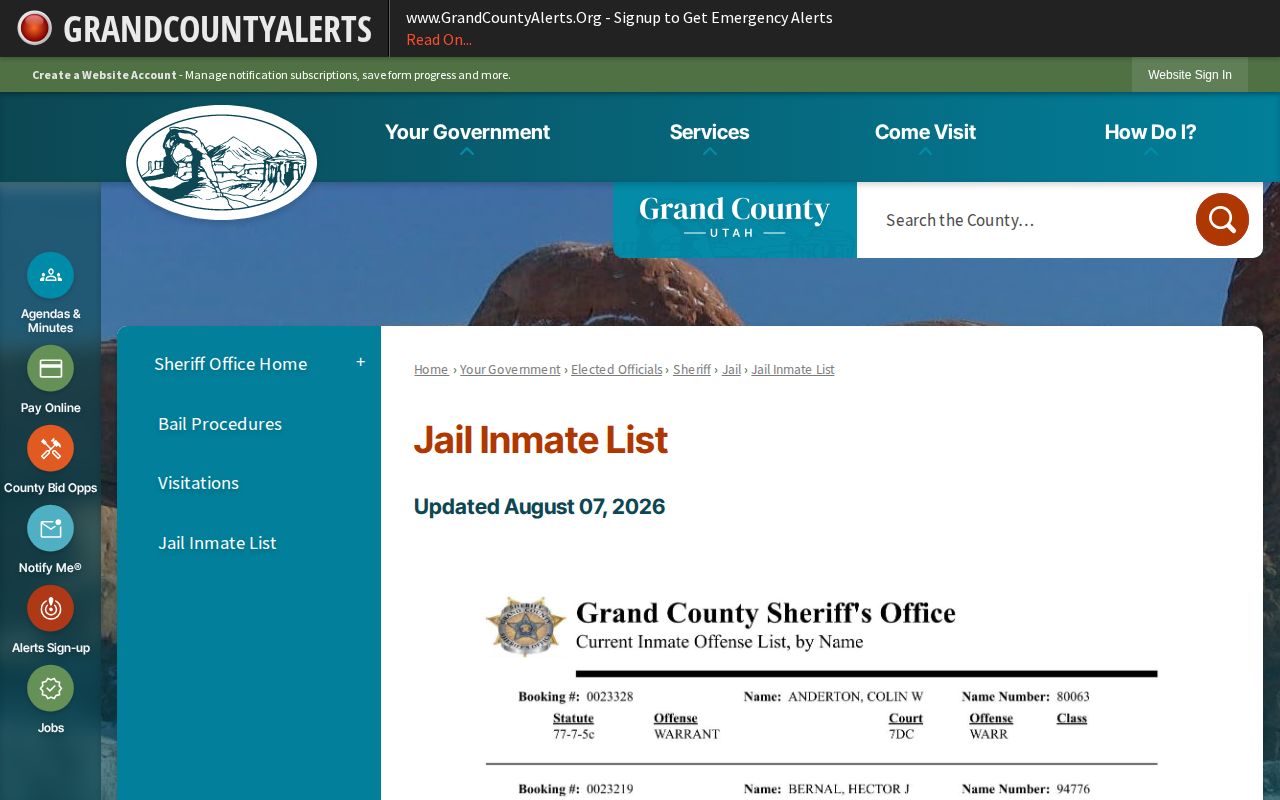
The captured page has no released-only control, so the next steps must come from the jail, GRAMA record, and court file.
Grand County Jail Records Contact
The jail contact is available around the clock, while the published administration schedule is limited to weekdays. The same county page also lists Sheriff's administration at a second Moab address. Confirm the correct counter before taking a paper request or visiting for a record. Booking and release documentation belongs with the Sheriff's Office, not with a court clerk or the nearby probation office.
Grand County Jail125 E. Center Street
Moab, UT 84532
Jail: 435-259-8115
Fax: 435-259-1364
Jail phone: 24/7
Administration: Monday through Friday, 8 a.m. to 5 p.m.
The Sheriff Forms and Documents page supplies the GRAMA process. It asks for identification, dates, a reasonably specific description, and a case number when available. The page states an ordinary response within ten working days and five working days for a qualifying expedited request. Those are response periods, not promises that a record will be disclosed in full.
A strong request asks for the native booking-and-release sheet, not a broad list of all data about a person. Name the booking number, approximate booking date, release date and time, release reason, releasing authority, destination agency, and charges or bond fields as recorded. Ask the custodian to redact restricted fields and provide the public remainder. If a fact appears wrong, identify the disputed field and attach the official document that supports the correction.
The official jail page is pictured below. Its contact details establish the correct starting office, though callers should still confirm where a request must be delivered.
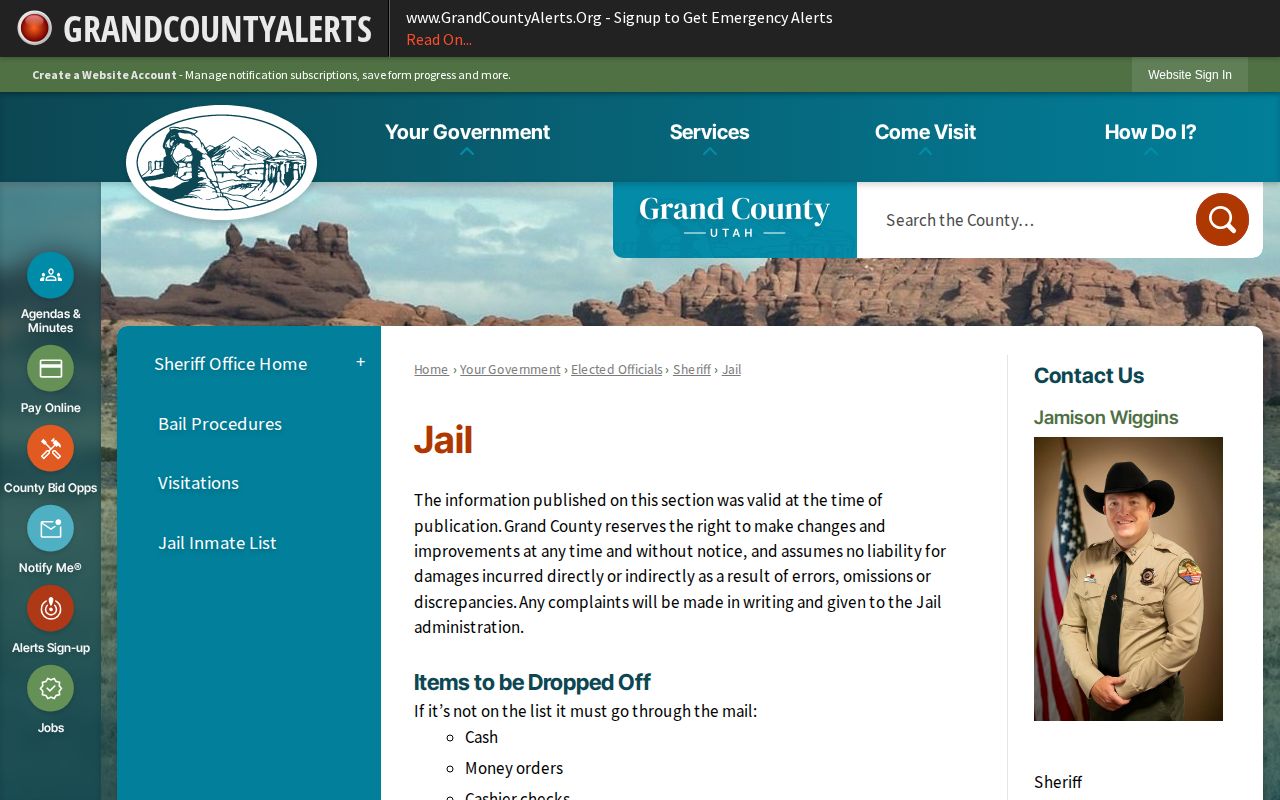
The image supports the facility identity and phone route, while the separate Sheriff form governs documentary access.
Note: Court staff can supply orders and docket entries, but they do not own the jail's operational release timestamp or destination field.
Grand County Jail Record Fields
Grand County corrections staff are responsible for booking and release documentation, computerized inmate records, authorized release, and transport to courts, state prison, or state mental facilities. That operational role supports a request for the actual release record. It also explains why “transfer” deserves its own label. A person transported to a state institution has left the local cell, but custody has not ended.
The public research does not establish one fixed local form with every possible field. Request the native record and its data definitions. A responsive booking-and-release sheet may contain these items, subject to classification and redaction:
| Requested field | Why it matters |
|---|---|
| Booking number and identifiers | Separates people with similar names and connects the roster to the case |
| Admission and release timestamps | Shows the recorded custody interval |
| Release reason and authority | Distinguishes bond, order, time served, and transfer |
| Destination or receiving agency | Shows whether another custodian took control |
| Charge, court, and bond fields | Provides the keys needed for the matching court file |
The record may omit, redact, or classify some items. Utah GRAMA allows different treatment for public, private, controlled, and protected material. Juvenile, victim, medical, investigative, security, sealed, and expunged details can be restricted. Ask for each denial or redaction to be tied to its legal basis rather than assuming every booking field must be open.
Grand County Bond Release Route
Grand County publishes a specific bail procedure. The jail does not take credit-card bail. The Seventh District and Grand County Justice Courts take credit-card bail during their stated weekday office hours, and bond transactions use the North Door at the 100 North Street entrance. That is a transaction point. It is not verified as the door through which every person physically leaves custody.
Bond release is a pretrial event, not a final disposition. The case can continue, and the person may remain subject to conditions monitored by Grand County PreTrial Services. That local function differs from UDC probation or parole. Pretrial supervision concerns a pending case after law-enforcement custody; felony probation follows a court sentence; parole follows a Board decision on a prison term.
Families should call before traveling. The county's directions for a bond payment should not be stretched into a pickup instruction, and a court receipt should be checked against the jail's actual release entry.
Grand County Custody Boundaries
A state inmate may be physically housed in a county jail while legally committed to UDC. In that case, the county roster can describe a bed location, but UDC and the Utah Board of Pardons and Parole control state status and release evidence. UDC says almost all state prisoners held in contract county jails are taken to the Utah State Correctional Facility for centralized Tuesday release. A rare release at the county jail is communicated to family.
- Release
- The end of a specific agency's physical custody.
- Transfer
- A move from one custodian to another, not necessarily freedom.
- Parole
- Release from prison while the state sentence and supervision continue.
- Discharge
- The later end of the sentence or supervision, as officially recorded.
If the county record says UDC, use the state offender search and Board order. If it says federal or immigration transfer, use the matching federal system. The Utah State Correctional Facility release page explains why a Grand County case can end with physical release in Salt Lake City.
Note: A current UDC search result may show a parolee or probationer who is not in prison, so read legal status and location separately.